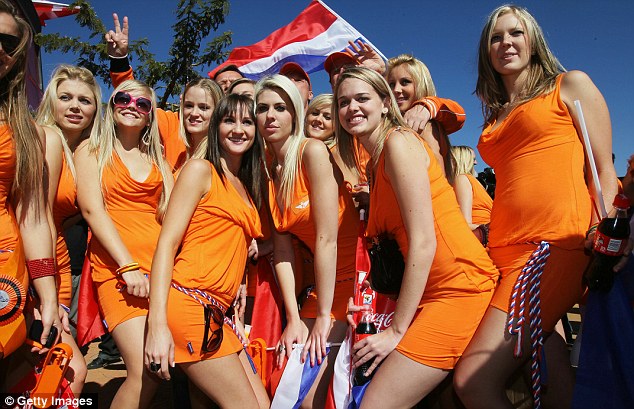
Since I was a kid I’ve been fascinated and slightly obsessed with the oranje, the Dutch national football team. Their victory at the 1988 European Championships was the first time I’d ever seen the men in orange play, and the fascination started from there. Ireland were ten minutes away from drawing with them in final group match of Euro ’88, a result which would have knocked out the Dutch and put Ireland through to the semi finals. The oranje scored a late winner to break Irish hearts, and the momentum from that win carried them to 2-1 over West Germany in the semi finals and then a 2-0 win in the final against Russia. Marco Van Basten was the star striker in that tournament and his exquisite volley in the final was the standout moment. Part of the fascination for me was not just the stylish and arrogant football they played but the bright orange jerseys. The sight of large swathes of the stadia taken over by thousands of orange bedecked fans really captured my imagination too.
The Euro ’88 tournament win was hugely significant in transforming the Dutch national team from perennial nearly men to actual winners. The 1970s had been a golden period for Dutch football with Ajax Amsterdam winning three consecutive European Cups from 1971-1973 playing Total Football, a style of play that ensured every player on the team was comfortable playing any outfield position. Ajax began it and the national team also applied it in the ‘70s, ensuring every player was technically proficient and comfortable in possession. The end result was that two highly gifted Dutch squads reached the final of World Cup 1974 in Germany and Argentina in 1978. And in both, the Dutch were beaten by the hosts. In each tournament it was generally regarded that they played the best football, though it only brought them second place.
Holland is a nation whose people who are never afraid to show their individualism and expression. And who always favour seeing their team play the beautiful game, sometimes even at the expense of victory. In his book ‘Brilliant Orange’, David Winner captures this mindset as ‘Holland’s morally superior beautiful losing’. Winning the Euro ’88 tournament put an end to the beautiful losing, temporarily at least. By the 1990s they were at it again, losing 3-2 to eventual champions Brazil in the quarter finals of USA 1994 and going one step further in France 1998. Again playing with style and free scoring, a squad of huge talent reached the semi finals only to lose on penalties to Brazil once again. Studying in Aachen, Germany in 1998 allowed me to travel to the Dutch border town of Vaals to watch that semi final with hundreds of locals. I really felt their pain after the penalty shoot out, but they would have taken some comfort knowing their team had provided many of the best moments and goals of the tournament. None better than Dennis Bergkamp’s last minute winner against Argentina in the quarter finals, one of the best World Cup goals in history for the combination of technique and timing in such a high stakes match.
https://www.youtube.com/watch?v=XsZkCFoqSBs
The Dutch have continued to provide many beautiful orange-soaked moments in tournaments in the 2000’s, and once or twice they again came close to winning outright by playing the best football until self-doubt once again set in. Euro 2000 is one example, where they blazed through to the semi finals and after dominating Italy throughout that match without scoring they eventually succumbed to penalties against the stronger minded Italians. At Euro 2008, they were installed as favourites after the group stage after topping the Group of Death with wins against Italy (3-0), France (4-1) and Romania (2-0) only to then succumb to the magic of Andrei Arhavin and Russia in the quarter finals, losing 3-1. In 2010 they again reached the World Cup final, in South Africa. In contrast to the teams of the ‘70s, the 2010 vintage was not as talented or refined technically and it was a mixture of luck and brutal tactics which paved the way to the final. Coming up against tournament favourites Spain in that final, the coach Bert van Marwijk decided that his squad could not compete with the Spanish on a technical or football level so he set his team out to disrupt their rhythm by trying to kick lumps out of them. Thankfully the tactic failed – just about – as the little genius Andre Iniesta scored with only minutes of extra time left in a dour final to secure the Spanish win. While the younger Dutch fans were proud of their team and saw each match as an excuse to dress up and party, the older generation were affronted by image of Dutch football portrayed in that final and in the tournament as a whole. Louis van Gaal partially managed to restore the traditional image in the first group match of World Cup 2014 with the unforgettable 5-1 mauling of the Spanish. Unfortunately, as the tournament progressed and stakes got higher Van Gaal toned down the flowing football and turned up the low risk approach. The end result was a fairly dull 0-0 semi final against Argentina which had been touted as a possible classic in advance. Ultimately, the Dutch lost once again on penalties and missed out on a place in the final.
Watch any World Cup or European Championship highlights programme from the 1970s onwards and there will be many beautiful moments gift wrapped in oranje. The Dutch people have a sense of pride in this aesthetically pleasing football, even though the results ultimately show one solitary tournament win – Euro ’88. Despite this, until the end of my days watching football I’ll always closely follow the Dutch in every tournament they play in and maybe throw on my Holland jersey now and again. There’s every chance they won’t win another tournament in my lifetime but are guaranteed to leave their mark on each one. The mark of brilliant orange.
 kingstonthoughts