A-Z Challenge 2015 – U is for Underdog

Irish sports teams down through history have generally performed better in the role of underdogs. This role is often attached to the Irish because of a smaller playing population than other nations in field sports, but it’s also tied into the Irish psyche. We are a people who are averse to bigging ourselves up. Eternally uncomfortable taking compliments. Those who do show confidence in themselves and are willing to broadcast it to others are automatically treated with suspicion! ‘Who does that fella think he is? He’s getting ideas way beyond his station’. That kind of thing. We’ve always viewed the confidence of the average American with bemusement. American people portraying the best of themselves in actions and words is viewed as something that makes them a bit strange to us. As if expecting the best possible service in restaurants and having no issue in sending food back is something to be ashamed of. ‘Oh, we can’t be seen to make a fuss’ or ‘Don’t be making a show of yourself’ would be likely responses by an Irish person at the restaurant table rather than sending something back. So more often than not we’ll tell the waiter or waitress that the dish is ‘grand’, even when we think the opposite.

In the sporting context, Ireland has revelled in the role of underdogs in rugby and soccer as prime examples. While we are now on an even par with the best in the world now in rugby, there were decades when Ireland were the poor relation in the old Five Nations rugby championship. But every so often during those years Irish pride kicked in against the auld enemy England, leading to famous Irish victories. The 2007 Rugby World Cup could be seen as an example of the favourites tag not suiting us. With Brian O’Driscoll in his prime and Ireland consistently finishing in the top two or three in the Six Nations during the 2000’s, we were rightly considered an outside favourite to win the 2007 World Cup. There are a bunch of reasons why it went so wrong at the tournament, as Ireland lost to both France and Argentina in the group stages and went home without making the knockout stages. Overconfidence was given as one of those reasons. It just doesn’t suit us! Give us the underdogs role any day and we’ll revel in it. Thankfully, this mentality is gradually changing within Irish rugby as two successive Six Nations championships has backed up Irish confidence in the teams ability. Having the best coach in world rugby in Joe Schmidt also helps. With the rugby world cup coming around again this September, all of Ireland is quietly confident that we can do something special. But whisper it!

On the soccer front, Ireland has always punched above its weight considering we don’t have a professional soccer league. After decades of failure, Ireland finally qualified for major tournaments under Jack Charlton with the 1988 European Championships and the 1990 World Cup. And in both cases, without being one of the fancied teams, they qualified from the group into the knockout stages. At our next two tournament appearances – 1994 USA World Cup and 2002 World Cup – again we overachieved and qualified for the second phase. We had to wait until 2012 before Ireland appeared in a major tournament, the European Championships in Poland. Despite a mixed qualification phase, the team was generally solid and it was generally felt that we had a fighting chance against group rivals Italy, Spain and Croatia. As it was we were well beaten in every game, finishing bottom of the group with no points. Granted it turned out to be the strongest group as Italy and Spain were the eventual finalists. But it seems the hype and euphoria of qualifying after so many years led to us getting ahead of ourselves and expecting too much. Perhaps if the entire country had written off our chances before a ball was kicked and accepted our fate as underdogs, then the performances and results would have been better!
A-Z Challenge 2015 – U is for Underdog

A-Z Challenge 2015 – O is for oranje

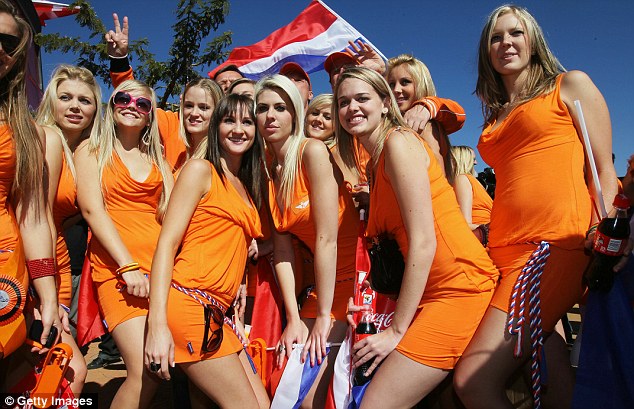
Dutch fans

Since I was a kid I’ve been fascinated and slightly obsessed with the oranje, the Dutch national football team. Their victory at the 1988 European Championships was the first time I’d ever seen the men in orange play, and the fascination started from there. Ireland were ten minutes away from drawing with them in final group match of Euro ’88, a result which would have knocked out the Dutch and put Ireland through to the semi finals. The oranje scored a late winner to break Irish hearts, and the momentum from that win carried them to 2-1 over West Germany in the semi finals and then a 2-0 win in the final against Russia. Marco Van Basten was the star striker in that tournament and his exquisite volley in the final was the standout moment. Part of the fascination for me was not just the stylish and arrogant football they played but the bright orange jerseys. The sight of large swathes of the stadia taken over by thousands of orange bedecked fans really captured my imagination too.

The Euro ’88 tournament win was hugely significant in transforming the Dutch national team from perennial nearly men to actual winners. The 1970s had been a golden period for Dutch football with Ajax Amsterdam winning three consecutive European Cups from 1971-1973 playing Total Football, a style of play that ensured every player on the team was comfortable playing any outfield position. Ajax began it and the national team also applied it in the ‘70s, ensuring every player was technically proficient and comfortable in possession. The end result was that two highly gifted Dutch squads reached the final of World Cup 1974 in Germany and Argentina in 1978. And in both, the Dutch were beaten by the hosts. In each tournament it was generally regarded that they played the best football, though it only brought them second place.

Holland is a nation whose people who are never afraid to show their individualism and expression. And who always favour seeing their team play the beautiful game, sometimes even at the expense of victory.  In his book ‘Brilliant Orange’, David Winner captures this mindset as ‘Holland’s morally superior beautiful losing’. Winning the Euro ’88 tournament put an end to the beautiful losing, temporarily at least. By the 1990s they were at it again, losing 3-2 to eventual champions Brazil in the quarter finals of USA 1994 and going one step further in France 1998. Again playing with style and free scoring, a squad of huge talent reached the semi finals only to lose on penalties to Brazil once again. Studying in Aachen, Germany in 1998 allowed me to travel to the Dutch border town of Vaals to watch that semi final with hundreds of locals. I really felt their pain after the penalty shoot out, but they would have taken some comfort knowing their team had provided many of the best moments and goals of the tournament. None better than Dennis Bergkamp’s last minute winner against Argentina in the quarter finals, one of the best World Cup goals in history for the combination of technique and timing in such a high stakes match.

https://www.youtube.com/watch?v=XsZkCFoqSBs

The Dutch have continued to provide many beautiful orange-soaked moments in tournaments in the 2000’s, and once or twice they again came close to winning outright by playing the best football until self-doubt once again set in. Euro 2000 is one example, where they blazed through to the semi finals and after dominating Italy throughout that match without scoring they eventually succumbed to penalties against the stronger minded Italians. At Euro 2008, they were installed as favourites after the group stage after topping the Group of Death with wins against Italy (3-0), France (4-1) and Romania (2-0) only to then succumb to the magic of Andrei Arhavin and Russia in the quarter finals, losing 3-1. In 2010 they again reached the World Cup final, in South Africa. In contrast to the teams of the ‘70s, the 2010 vintage was not as talented or refined technically and it was a mixture of luck and brutal tactics which paved the way to the final. Coming up against tournament favourites Spain in that final, the coach Bert van Marwijk decided that his squad could not compete with the Spanish on a technical or football level so he set his team out to disrupt their rhythm by trying to kick lumps out of them. Thankfully the tactic failed – just about – as the little genius Andre Iniesta scored with only minutes of extra time left in a dour final to secure the Spanish win. While the younger Dutch fans were proud of their team and saw each match as an excuse to dress up and party, the older generation were affronted by image of Dutch football portrayed in that final and in the tournament as a whole. Louis van Gaal partially managed to restore the traditional image in the first group match of World Cup 2014 with the unforgettable 5-1 mauling of the Spanish. Unfortunately, as the tournament progressed and stakes got higher Van Gaal toned down the flowing football and turned up the low risk approach. The end result was a fairly dull 0-0 semi final against Argentina which had been touted as a possible classic in advance. Ultimately, the Dutch lost once again on penalties and missed out on a place in the final.

Watch any World Cup or European Championship highlights programme from the 1970s onwards and there will be many beautiful moments gift wrapped in oranje. The Dutch people have a sense of pride in this aesthetically pleasing football, even though the results ultimately show one solitary tournament win – Euro ’88. Despite this, until the end of my days watching football I’ll always closely follow the Dutch in every tournament they play in and maybe throw on my Holland jersey now and again. There’s every chance they won’t win another tournament in my lifetime but are guaranteed to leave their mark on each one. The mark of brilliant orange.

A-Z Challenge 2015 – O is for oranje

A-Z Challenge – J is for June 1990

June 1990 – One of the most memorable months in the history of Irish sport, and soccer in particular. Ireland’s maiden World Cup tournament at Italia 1990 and the entire country came to a standstill for the month of June! After our decent showing at the Euro ’88 finals – Irelands first ever appearance in a major international soccer tournament –  Jack Charlton’s team impressively qualified for the World Cup. As the anticipation and excitement built ahead of the first match against arch rivals England on June 11th, a wave of optimism and nationalistic fervour swept the country. Despite being in the tail end of a recession, families and communities joined together and turned streets, parks and gardens into a celebration of colour as the green white and gold was everywhere. Bunting, flags, even inflatable tri-coloured hammers! Women waved good bye to their men for a month as several thousand Irishmen spent life savings or took out loans to get to Cagliari on the island of Sardinia by any means necessary in time for our first match. Planes, trains, and automobiles. And boats of course! The 1-1 draw on a sweltering June night was not pretty to watch but was celebrated at home as if we’d won.

Six days later the optimism at home was tempered somewhat as Ireland played out a very dull and frustrating 0-0 draw in the Sicilian sunshine against Egypt, the group outsiders. So Irish fate came down to a final group match against favourites and European Champions the Netherlands, on another hot night in Palermo, Sicily. Cue high drama once again! The Dutch were packed with world stars of the highest technique and one of them – Ruud Gullit – put them ahead after only ten minutes. Ireland gradually found a foothold and Niall Quinn forced an equaliser in the second half after a goalie error. The draw put both teams through to the next round.

On June 25th Ireland faced Romania in the afternoon sun in Genoa in the last sixteen, and after ninety minutes plus thirty minutes extra time neither team had scored. The players sizzled on the pitch, the fans had sweat buckets in the stands and back home the country overheated too as we faced into a penalty shoot out for the first time in our history. We watched through our fingers. Five successful kicks and one miraculous Pat Bonner save later, we had qualified for the quarter finals against the hosts and favourites Italy in Rome…the dream continued! And Rome is where the dream ended unfortunately, as Italy won a cagey match 1-0 in Rome on the final day of June.

Ireland were accused of negative and boring tactics in World Cup 90 by Irish and foreign media. Two goals in five matches backed up the argument. But that’s forgetting the real story, where a team had brought together a nation in economic turmoil and gave us four weeks of unbelievable pride and drama against some of the best football nations in the world. For a twelve year old like myself, it cemented an obsession with football and international football in particular. Watching my country hold their own in the sweltering Italian heat against world stars mean’t so much. And I was mesmerised too by the stars of that tournament who illuminated many cagey matches with moments of brilliance…Matthaus, Caniggia, Scifo, Stojkovic, Schillaci.

Half a million people lined the streets of Dublin city centre to welcome home the Irish team…that would have been around one eighth of the Irish population in 1990! My memories of watching that welcome ceremony on TV were not just pride but regret and sadness that we had not beaten Italy and gone further. Such was the hope the team gave us. They gave us one unforgettable summer, and their legacy went much further than that with the Irish baby boom in early 1991!

A-Z Challenge – J is for June 1990